


For many organizations, Dynamics Great Plains (GP) has been a reliable system for a long time. It runs core financial processes well, teams are comfortable with it, and in many cases it feels like it still “works.” Because of that, the decision to move away from GP is rarely urgent, and it shouldn’t be rushed.
At the same time, most companies know change is coming. Technology expectations are different than they were even five years ago. Remote work is normal. Reporting expectations are higher. Integrations matter more. And long upgrade cycles feel harder to justify when the business is moving quickly.
We work with organizations every day that are trying to decide whether to stay on GP a little longer or begin planning a move to Business Central. There is no universal right answer. What matters is understanding the real differences between the systems and choosing the timing that aligns with how your business operates. This guide is designed to help you do exactly that.
Why Companies Are Still on Dynamics GP
Dynamics GP did a lot of things right, and that is why it is still widely used. It is stable, familiar, and deeply embedded in the daily operations of many finance teams. Over the years, companies have built processes, reports, and integrations around it, and that investment creates loyalty.
We often hear:
- “It still works for what we need.”
- “Our team knows it inside and out.”
- “We’ve customized it to fit how we operate.”
Those are all valid reasons to be cautious about change. An ERP system touches every part of the business, and disruption carries real risk.
What Has Changed Around GP
The biggest shift is not that GP suddenly stopped working. The shift is everything happening around it.
Technology ecosystems have moved to the cloud. Employees expect access from anywhere. Security expectations are higher. Data is expected to be available in real time, not exported and reworked manually.
GP was designed for a different era. While it can be extended and maintained, those extensions often rely on third-party tools, custom development, or workarounds that increase complexity over time.
As support models, licensing structures, and upgrade paths continue to evolve, companies are being forced to ask not “Can we stay on GP?” but “Should we?”
What Business Central Is Designed to Do

Business Central is Microsoft’s modern ERP platform for small and midsize businesses. It is cloud-based, continuously updated, and built to integrate naturally with Microsoft 365, Power BI, and the Power Platform.
The biggest difference we see is how Business Central supports the way companies work today:
- Access from anywhere without complex infrastructure
- Regular updates without large upgrade projects
- Built-in reporting and analytics
- Easier integrations with other systems
- A more flexible foundation for automation
Business Central is not GP in the cloud. It is a different system with a different architecture and philosophy.
The Most Common Misconception About Migrating
One of the biggest misconceptions we encounter is the idea that migrating to Business Central is simply a technical conversion. In reality, the most successful projects treat migration as an opportunity to align the system with how the business actually runs today.
When migrations struggle, it is rarely because of the software. It is usually because:
- Old processes were carried forward without question
- Data was moved without cleanup
- Decisions were deferred until late in the project
- The system was designed around assumptions instead of real workflows
That is why planning and honest assessment matter far more than speed.
When Staying on Dynamics GP May Still Make Sense
There are fewer scenarios today where staying on Dynamics GP is the right long-term answer, and it’s important to be honest about that. Microsoft has already announced the eventual end of support for GP, and older versions are no longer supported. As time goes on, companies remaining on GP should expect increasing challenges.
That said, there are limited, practical situations where remaining on GP temporarily can still make sense.
Staying on GP may be reasonable when:
- The organization is in the middle of a corporate merger or acquisition and plans to consolidate onto a different ERP within 2026 or 2027.
- The business is in the process of winding down operations or planning an exit in the near term.
- A system change is contractually or operationally blocked in the short term, such as during a major audit or regulatory review
In these cases, the goal is usually stability during a transition period, not long-term optimization.
What’s important to understand is that staying on GP is no longer a neutral decision. As Microsoft support phases out, companies are more likely to encounter challenges such as:
- Increased security risk on unsupported versions
- Fewer qualified resources available to support and troubleshoot issues
- Compatibility problems with newer operating systems, databases, and integrations
- Higher reliance on customizations and workarounds to maintain functionality
These risks don’t always appear all at once, but they tend to compound over time.
If a company decides to remain on GP temporarily, it should be with a clear plan, defined timeline, and an understanding of the trade-offs involved. Without that, the risks can quietly outpace the perceived benefits of staying put.
When Business Central Becomes the Better Option
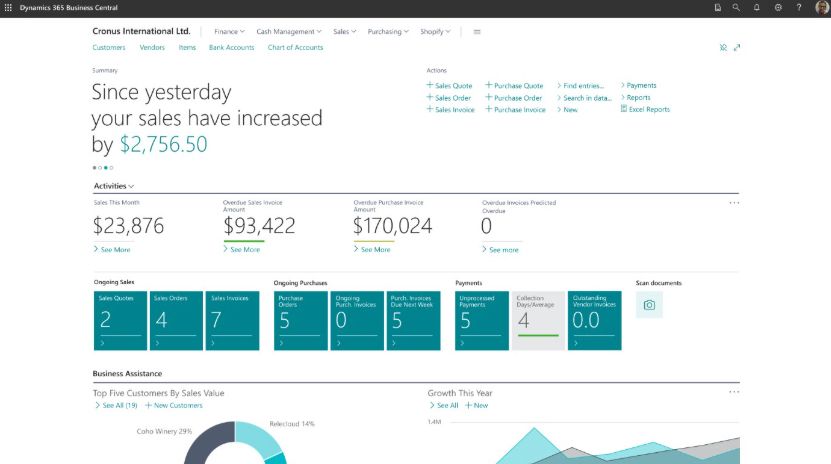
We typically see Business Central become the better fit when companies start to experience friction with GP rather than outright failure.
Common signs include:
- Reporting requires too much manual effort
- Remote access and collaboration are cumbersome
- Integrations are difficult or brittle
- Upgrades feel risky or costly
- Growth introduces complexity GP was not designed to handle
At this stage, companies are often spending significant time and money just keeping things running smoothly.
The Role of Timing and Preparation
Timing matters more than many people realize. Moving too early can create unnecessary disruption. Waiting too long can increase cost and risk.
The most successful migrations we see share a few characteristics:
- Clear understanding of current processes
- Commitment to data cleanup
- Executive alignment on goals
- Willingness to adjust workflows where it makes sense
- A partner who is honest about what Business Central will and will not solve
How We Approach GP to Business Central Migrations
Our philosophy is simple. We focus on understanding how your business actually operates before we touch the technology.
We spend time walking through day-to-day workflows. We identify what works well today and what causes friction. We help teams decide what should be carried forward and what should change.
Clients often tell us they value this approach because it reduces surprises and avoids unnecessary customization. It also keeps projects focused on outcomes instead of features.
What This Decision Really Comes Down To
Choosing between staying on GP and moving to Business Central is not about chasing the newest system. It is about alignment.
The right decision supports your people, your processes, and your long-term goals. It balances stability with flexibility. And it is made with clear information rather than pressure.
If you are evaluating your next step, whether that means staying where you are a little longer or beginning to plan a move, having an honest conversation is the best place to start. At Integrato, that is how we approach every ERP decision. Doing what is right for the client, even when the answer is not to move yet.